
Blog · Guide
AI Receptionist for Welding and Fabrication Shops: Quote Requests Should Not Die in Voicemail
A welding shop is one of the loudest, least phone friendly places a small business can operate. You are under a helmet, gloved up, with an arc going and a grinder running two benches over. The phone rings, nobody hears it, and a contractor who needed a rush bracket fabricated by Friday moves on to the next shop in the search results.
By Samana Rob · Published August 7, 2026 · Contains affiliate links
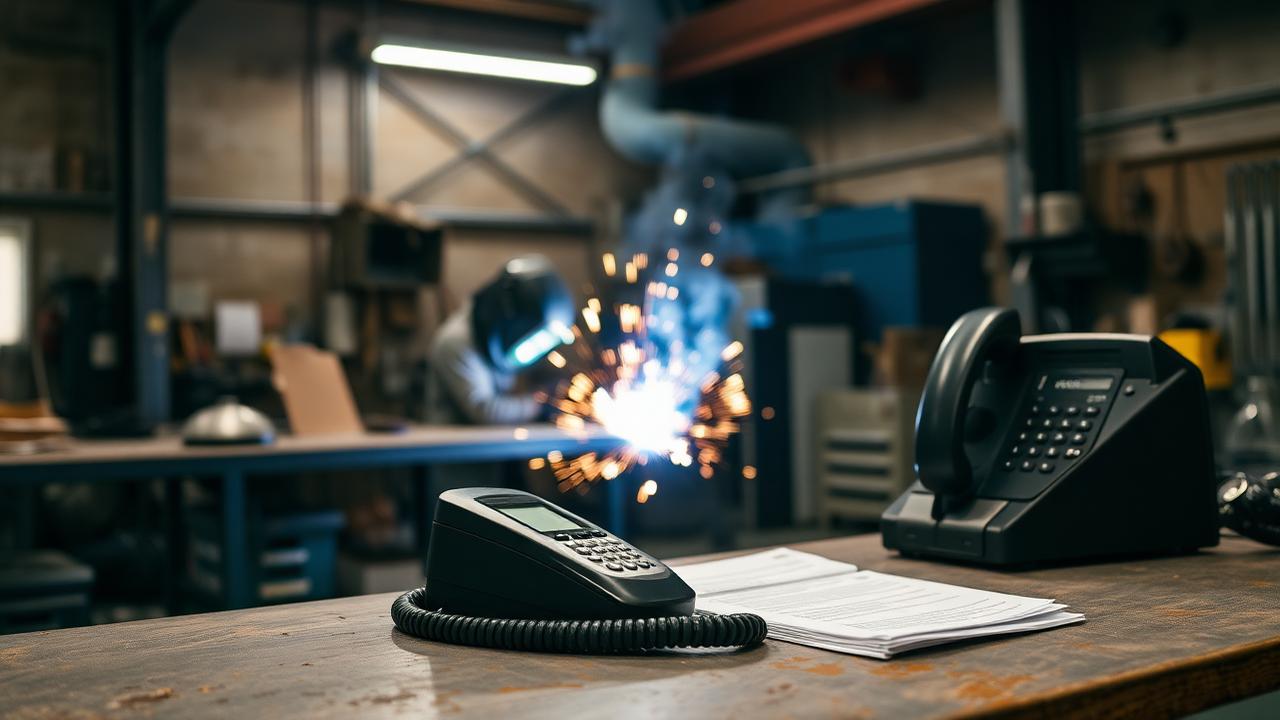
You cannot answer a phone with a torch in your hand
Fabrication work is committed work. Once the arc is struck, the puddle is live and the joint is either going to come out right or it is going to come out expensive. Stopping mid bead to grab a ringing phone is not a real option for anyone who cares about the weld.
The environment makes it worse. Between the exhaust fans, the grinders, the plasma table, and a helmet on your head, a ringing phone twenty feet away is functionally silent, and the ear protection that keeps your hearing intact also keeps you from ever knowing the call happened.
Shop safety guidance from OSHA on welding, cutting, and brazing exists for a reason, and none of it improves when a welder is rushing to reach a phone. Keeping the phone out of the shop floor entirely is the safer arrangement anyway.
Quote requests do not leave messages
A general contractor who needs twelve steel brackets by Thursday has a list of four shops. They call the first one, and if a person answers and sounds capable, the other three names on that list never get dialed at all.
Very few of those callers leave voicemail. Custom work is a conversation, and a caller who has to explain a drawing to a machine that beeps at them will simply hang up and try the next shop instead of trying to describe a flange over a recording.
The jobs you lose this way are invisible in your books. Your revenue is just slightly lower than it should be every month, and there is no line item anywhere that says a contractor called at two thirty and gave up.
What a real fabrication intake captures
The difference between a lead and a quotable job is information. Most shops write down a name and a rough description on a scrap of paper, then spend two more phone calls filling in the parts they actually needed to price the work.
- Material type and thickness, including alloy if known
- Overall dimensions and quantity of parts
- Process needed, whether MIG, TIG, stick, or aluminum work
- Tolerance requirements and finish, painted, powder coated, or raw
- Whether drawings, sketches, or photos exist and how they will be sent
- On site repair or in shop work, with the site address if mobile
- Deadline and whether the job is a rush
- Company name, trade, and how they found you
When that arrives as a complete sheet, you can price the job during a coffee break instead of scheduling a second phone call. Faster quotes win more work, and in fabrication the speed of the quote often matters as much as the number on it.
Rush repairs versus routine quotes
A broken bucket pin on an excavator at seven in the morning is a different call than a homeowner asking about a decorative railing. One is stopping a jobsite from working and the other can wait until Tuesday without anybody being upset.
Your AI line should know the difference by rule, not by tone. Equipment down, structural failure, or anything blocking a crew from working pages you directly. Everything else queues up neatly for whenever you take your helmet off.
That distinction is what makes after hours coverage tolerable. You are not answering your phone all night, you are only being interrupted for the jobs that pay a premium precisely because they cannot wait.
A Wednesday afternoon in a two man shop
Two welders, one plasma table, and a phone on a dusty desk by the door. Between one and four in the afternoon the phone rings six times. Nobody hears four of them, and the two that get caught interrupt a fit up that then has to be re clamped.
Of the four missed calls, one was a repeat contractor with a forty piece bracket order, one was a trailer repair worth six hundred dollars, one was a homeowner asking about a gate, and one was a supplier confirming a delivery. Three of the four had money attached to them.
With an AI line, all six calls are answered without a single interruption on the shop floor. The bracket order arrives as a full spec sheet, the trailer repair is flagged as a same week job, the gate inquiry is qualified and queued, and the supplier confirmation is just a note in your inbox.
The cost math for a fab shop
Hiring even a part time office person for a small shop runs well past a thousand dollars a month once payroll costs are counted, and they still leave at three in the afternoon while contractors keep calling until six or seven at night.
A per minute answering service seems cheaper until bidding season, when a burst of long quoting calls turns into an invoice that undoes the margin on the very jobs those calls produced. The pricing model works against you exactly when business is good.
Flat pricing at $720 a month is easier to plan around. It is roughly the margin on one modest fabrication job, and everything past that first recovered job in the month is money that would otherwise have gone to the shop down the road.
Setting it up in a working shop
- List the processes and materials you do and do not take on
- Set your minimum job size and your service radius for mobile work
- Write the intake fields you need on every quote request
- Define what counts as an emergency worth paging you for
- Set up an email or text address for drawings and photos
- Forward the shop line, then read a week of transcripts and tighten the script
A lot of shops start with overflow only, letting the AI pick up after five rings when nobody hears the phone. Once the owner sees a few complete spec sheets land instead of blank voicemails, coverage usually expands to the whole day plus nights and weekends.
What it should never do
It should never quote a price on custom fabrication, never promise a delivery date the shop has not confirmed, and never commit to a process or a material spec on your behalf. Those are engineering decisions and they belong to the person who has to make the part.
It also should never pretend to understand a drawing. The right behavior when a caller starts describing geometry is to capture the description word for word, request the file, and get it in front of you rather than paraphrasing something that could be read three different ways.
Related reading
Ready to stop losing calls?
Try the AI receptionist that answers every call for one flat fee
No per minute charges. No missed leads. atAnswer covers your phones and website chat 24/7, and you can hear it for yourself on a live demo call.
$720/mo flat rate · Cancel anytime · Setup in minutes
Frequently Asked Questions
Can an AI receptionist really take a fabrication quote request?
It takes the information a quote is built from rather than pricing the job. Material type and thickness, dimensions, quantity, finish, tolerance requirements, whether drawings exist, delivery or pickup, and the deadline. You price it from a complete sheet.
What if the caller does not know their specs?
That happens constantly, and the script handles it. When a caller cannot answer a spec question, the AI captures what they do know, asks for photos or a drawing by text or email, and books a shop visit or a callback with the right person.
Will it quote a price over the phone?
No, and it should not. Guessing a price on custom fabrication is how shops lose money. The AI can share your shop rate or minimum charge if you want it to, then routes the job to you for a real number.
Can it handle mobile welding and emergency repair calls?
Yes. Breakdown and on site repair calls get flagged as urgent, with location, equipment type, access details, and whether the site has power. Those page you directly while routine quotes wait for morning.
Does it work for a one man shop?
Especially for a one man shop. When you are the welder, the estimator, and the office, every call is an interruption that costs a weld, and every missed call is revenue nobody ever tells you about.
Can it filter out the callers who are wasting my time?
It qualifies rather than rejects. Minimum job size, service radius, and whether the caller is a contractor or a homeowner all get captured, so you can decide who gets a same day callback and who gets a standard queue slot.
What does it cost for a small fab shop?
A flat $720 a month with unlimited calls. One recovered fabrication job of any real size typically covers several months of that, and busy bidding weeks do not raise the invoice at all.
24/7 call coverage · One flat monthly rate
Catch Every Quote Request, Helmet Down
Hear how atAnswer handles a real fabrication call, 24/7, $720 a month flat.
Affiliate link · Pricing, offers, and features can change at any time.